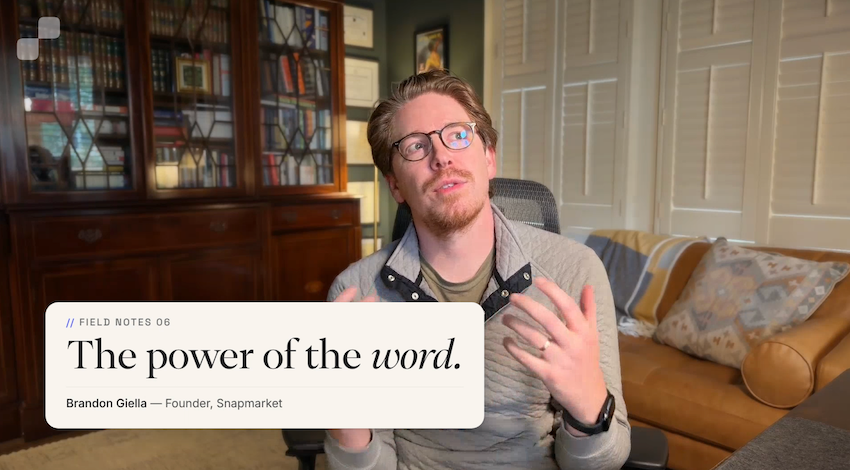
I have this new vigor and energy for the power of the word. What I mean by that is I think we can actually speak the future into existence. Not in a woo-woo, visualization, manifestation way. I mean that we need an imagination. We need a hope for what is possible. We need language for something we can’t yet even see.
That’s what I’ve come to love about marketing. I haven’t always loved it, and I haven’t always thought of myself as a marketer. But I’m coming to love it as a discipline, a practice, a craft, because it creates an imagination that can change the future when people imagine something new for themselves and for their business.
The philosopher J. L. Austin talks about how to do things with words. In the Christian tradition, God creates the world by speaking it into existence, and Jesus is called the Logos, the Word.
There’s something to harnessing the power of language to change the world, and that’s what marketing can do on a much smaller scale: a business casting a new vision for a new audience, renewing its vision for its current one, or defining its culture as a team.
I’ve seen it give teams confidence, a clearer vision of who they are, where they want to go, and how they want to show up in the world. I’ve seen it in my team, and in my clients and their teams. Our words, and therefore our ideas, are arguably the most powerful thing in the world. The pen is truly mightier than the sword.
Even the tiniest details matter. I love punctuation. I’ve always been a big fan of sentence case in headlines, because capital and lowercase letters—majuscules and minuscules—are a choice we made as a society. Em dashes, as much as AI wants to use them, are actually useful. Semicolons, apostrophes, and periods all change the way a sentence is shaped and what it means.
Take John 3:16: “For God so loved the world…” Some red-letter Bibles print it as the words of Jesus, but it could have been John. Two thousand years ago, we literally hadn’t invented quotation marks, so we’re not actually sure who said it. I just find that fascinating.
So as you write on LinkedIn, whether you use AI or not, remember that your words are a speech act. When you promise to do something, you create a social contract between two people. Whether you end with an exclamation point or a period really matters.
I’m convicted. Maybe this is a confession that I should have taken this more seriously. It’s important to get our words right, to make sure what we communicate is accurate and represents who we are and who we want to be, so we can give people a hope and a future and help them imagine new things.
This only becomes more important as machines do more of this work for us. AI is a real help. It’s a great editor. But there’s an imagination only a human can provide, and a social contract between two people, or between a company and its audience, that only a human can enter into. A robot cannot be held accountable for what it says, but you can. I think that’s a beautiful thing.