A system, but for people
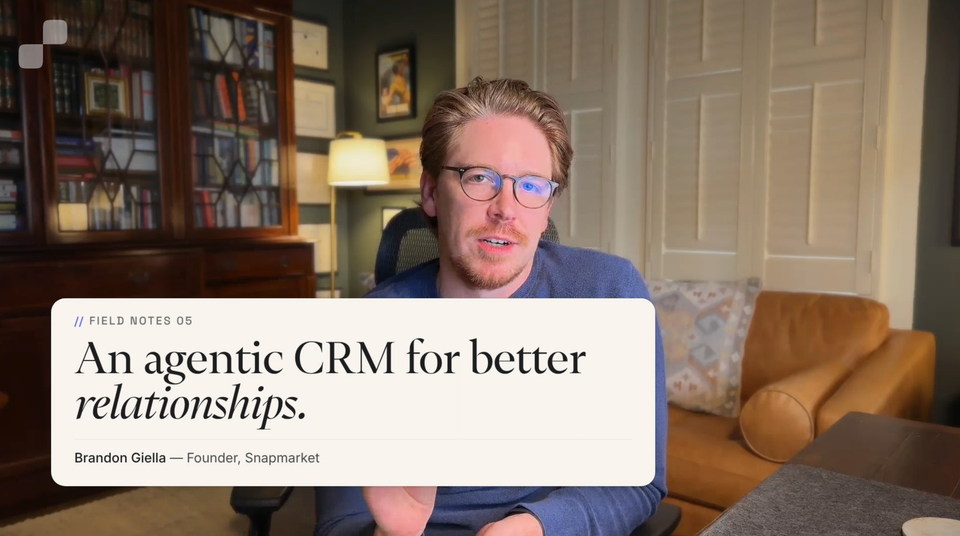
I need to reconsider how powerful an agentic CRM has been for me. For a long time, I neglected it. With a premium, close-knit offering like Snapmarket’s, I thought since I didn’t need that many clients, I didn’t need a robust platform. I could keep most of it in my head or in my inbox.
I don’t think that’s true anymore because of the context a machine can create about a person.
I’ve always wondered whether I could recreate what’s in my head about people—everything I know about them—in a machine. The answer is no. Most of what we know is implicit knowledge, not explicit knowledge. I can’t teach somebody else how to pick out a face in a crowd. But there’s a lot of context in digital communication: email, Slack messages, LinkedIn networks, comments. I’m rediscovering the value of all of that context, particularly if a machine can read it.
It’s whom you know
I have a real appreciation for relationships and the power of social capital. A couple years ago, when I got laid off from my job, I discovered how much social capital I’d built over the years. I started reaching out to people to see if I could help them, and it became this really beautiful, mutual relationship building. I’d built a foundation over the ten years I’ve been in marketing, but I didn’t realize it was there.
It impressed upon me the power of people. It’s not what you know but who you know—or whom you know, to be grammatically correct. I’ve really come to believe that everything boils down to stories and people.
Reconnecting, in phases
Agentic CRM is the term Attio, our CRM, likes to use. Attio understands the structured data behind your people: the activities, the relationship strength, all of that. Combine it with agentic tools like Claude, and it becomes a platform that can power everything in sales and marketing. We’ve implemented Attio for a few of our clients, and it’s been really helpful.
Lately I’ve been thinking about a phased approach to reconnecting with people:
- Email. There are literally thousands of people I’ve connected with by email over the last couple of years, and a lot of great people I should reconnect with.
- LinkedIn. I have almost two thousand connections there, and I’d never seen them as a dataset, or a source of social capital. I downloaded them, and I’m cross-referencing them with my email connections.
- My posts. As I publish on LinkedIn, I can find the people engaging with that material and bring their email addresses back into the system.
- Others’ posts. I can find who’s connecting with competitors and influencers, and reach out to them as well.
A system for people
Here’s what I’m finding: The more we can build a system for people, the better—not to systematize people or extract value as if they’re little pieces of data. They’re flesh-and-blood human beings with hopes and dreams and families, and I want to be there for that.
So what I’m thinking about is whether I can use the best of what machines are able to offer to connect with the people who will add a lot of value to each other’s lives. There’s an old professor I reconnected with this way, for example. And it gets the weight I’ve been feeling for years off my shoulders, out of my head, and into a system other people can use.
It’s still early days. Who’s someone you’ve lost touch with that you’d love to take to lunch? Reply and tell me.