The founder-to-firm system
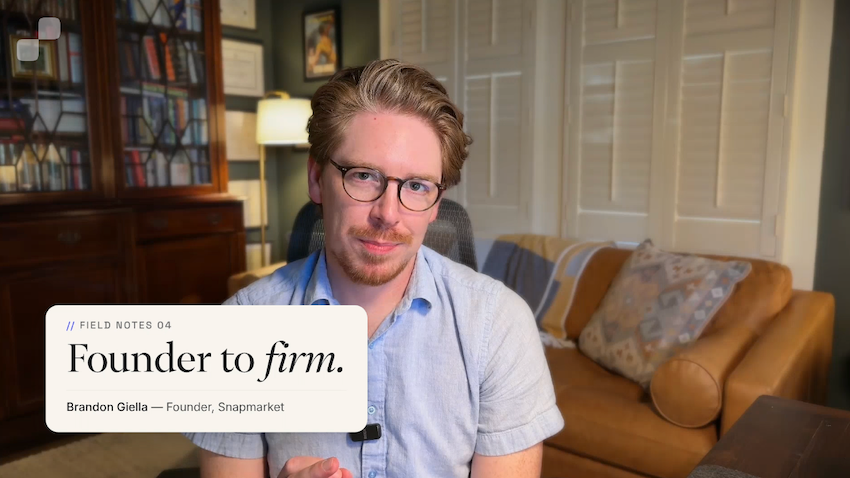
Most of the people we work with have the same problem. As founders, experts, or senior leaders in their companies, they are often the bottleneck to growth. A lot of the progress in the business still relies on them. It’s a very common problem, and hello, it’s me too.
Lately I’ve been realizing my own limitations as a founder and how much gets stuck in my head. But if I can keep putting it down on paper (digital paper, of course), my team feels empowered to take it on and grow beyond what I’m capable of. We’ve started calling this the founder-to-firm gap, and I think there are four steps to closing it.
Story
First, get your knowledge onto digital paper that people can read and, more importantly, that AI can read. We’re finding a lot of success using podcasts, recordings, and call transcripts to get everything out of a founder’s or expert’s head and into a repository—we use Markdown files and GitHub—that can be surfaced to build many, many assets after that.
That includes a brand identity. The animations in today’s video, for example, come from AI-ready style guides that our video editing tools can pull together very quickly.
System
Second, map out an integrated system where all of the tools talk to each other. A client who started with us last week had older tools like Squarespace and Mailchimp. To be effective in their marketing, they had to update a lot of those tools by hand, because their Claude couldn’t connect to them. So we connected their databases, CRM, and email, pulled all of that data together, and rebuilt the architecture so AI agents can read it and build from it. It was incredible.
It requires being thoughtful about what connects to what. We’re finding three pieces are key:
- A CRM, like Attio.com
- An agentic-ready website, like one built in Framer.com
- A knowledge base, like ours at docs.snapmarket.co
Send
Third, record something on a regular cadence—a ten-minute video, a thirty-minute podcast—and chop it up into a bunch of different assets. Three years ago, when we started, nobody was really doing that. It’s more popular now, and for good reason. The way it performs in the data across our clients is impressive—not perfect, but an incredible foundation.
Scale
The last step is really a layer that runs underneath all of the others. Once your message, brand, and system are in place, we can take that data and build what we’re calling pitch portals: templated but beautiful presentations, custom to your business and to your prospects.
Also, as you publish on LinkedIn, we can see who engages with your content, bring them into your CRM via their email addresses, draft outreach to them, and bring them back to a pitch built just for them.
Tied together, story, system, send, and scale bridge everything from marketing strategy to sales outreach and pipeline in your CRM.
That’s the founder-to-firm system.
It moves a firm beyond its founder so the team can take over, because the context, skills, and platforms are now system-wide instead of living in one person’s head.
It’s just fun to imagine where your business can go with the right tools in place. I’m encouraged about 2027, and I hope you are too.
Where does growth in your firm still depend on you? If you’re thinking about moving from a founder to a firm, reply and let’s talk.