Building an agent-ready business

For the last few months I’ve been venturing down the red-pilled rabbit hole of agentic processes built on the latest advancements in AI. I’m getting more and more calls about how to best leverage AI in our clients’ businesses, so I’ll write down what I just told a client yesterday.
Document everything in GitHub.
Think of your AI initiative like you’re training a new intern who just graduated from college. They’re smart and capable, but they have no experience or expertise, and they certainly have no knowledge of your business or how you do things. To get the most out of that person, you have to tell them in detail what to do. This is easier said than done.
It might sound daunting to write down everything you do. What I recommend is to conduct a series of interviews with yourself or others based on your entire customer journey from A to Z. Record those calls. Use the transcript to generate a first draft with Claude. Then you can edit that draft. You’ll be surprised how fast you can generate this knowledge base.
Get that knowledge into GitHub before you do anything else. Why GitHub? Because the different platforms don’t talk to each other, yet they need shared context. GitHub acts as a file system with which your team can collaborate. It also has version control, which is essential to ensure this precious info stays well organized over time.
GitHub houses markdown files, which are lightweight documents that can be easily read by machines. The lightweight part is important. LLMs can only handle so much information at a time, so having simple context files they can interpret about your business, processes, and team vastly improves the outputs from these tools.
Here’s how I set up our files.
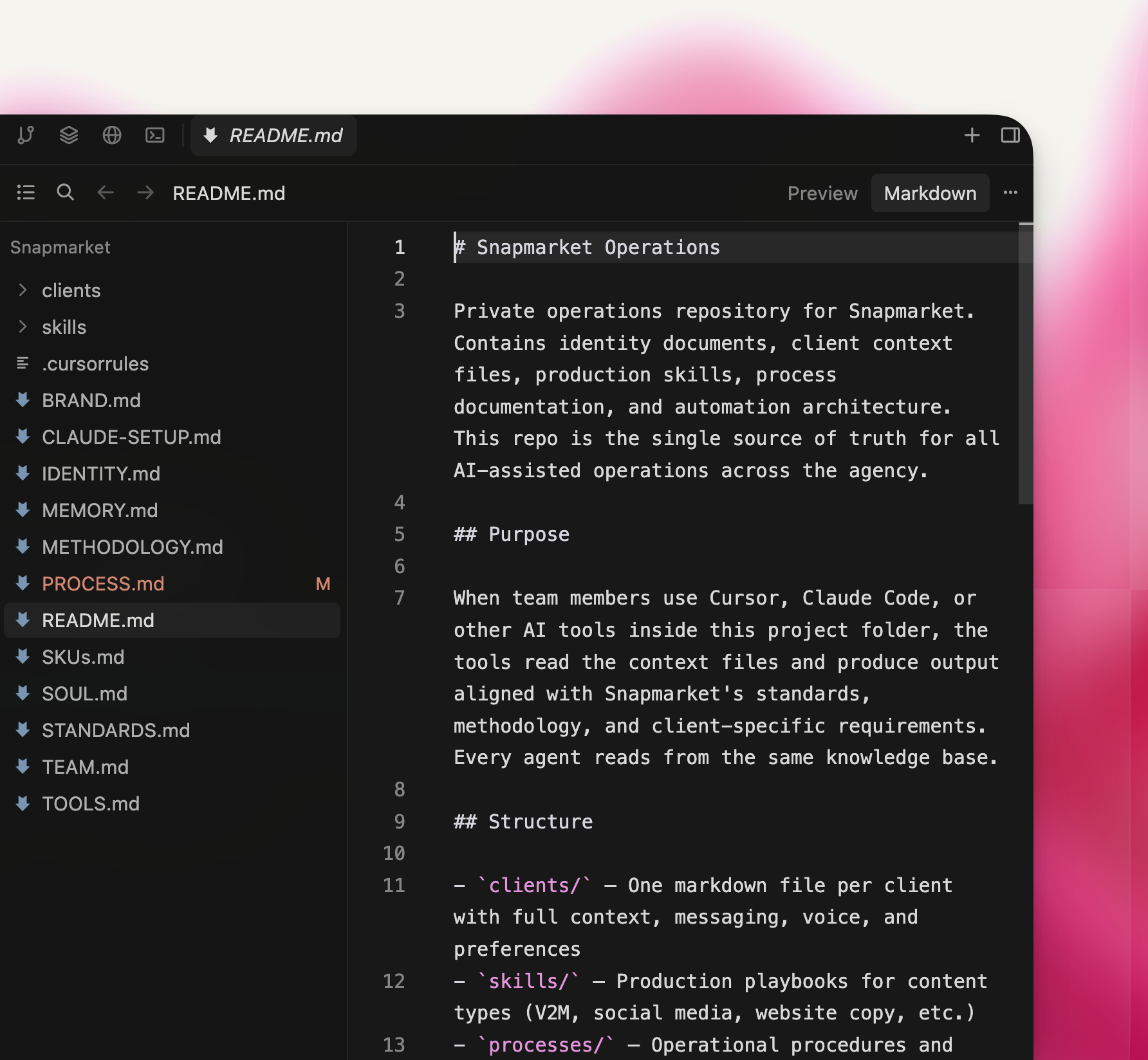
The files that help the AI systems best understand Snapmarket are SOUL.md, IDENTITY.md, and BRAND.md.
The SOUL.md file gives the ethos or wisdom or culture of what we’re aiming for as a company, things like our take on the limits of knowledge, the coordination problem, our emphasis on craftsmanship, and so on. You can read these ideas on our blog at notes.snapmarket.co.
The IDENTITY.md file merely describes what Snapmarket the business is, just as you’d find in any business publication—a marketing agency based in Fort Worth, TX, with these services and so on.
The BRAND.md file codifies our visual identity such that our tools can read what things should look like.
METHODOLOGY.md and PROCESS.md describe how we do what we do from an approach standpoint as well as textual flowchart of work moving through the customer journey from sales to retention, respectively.
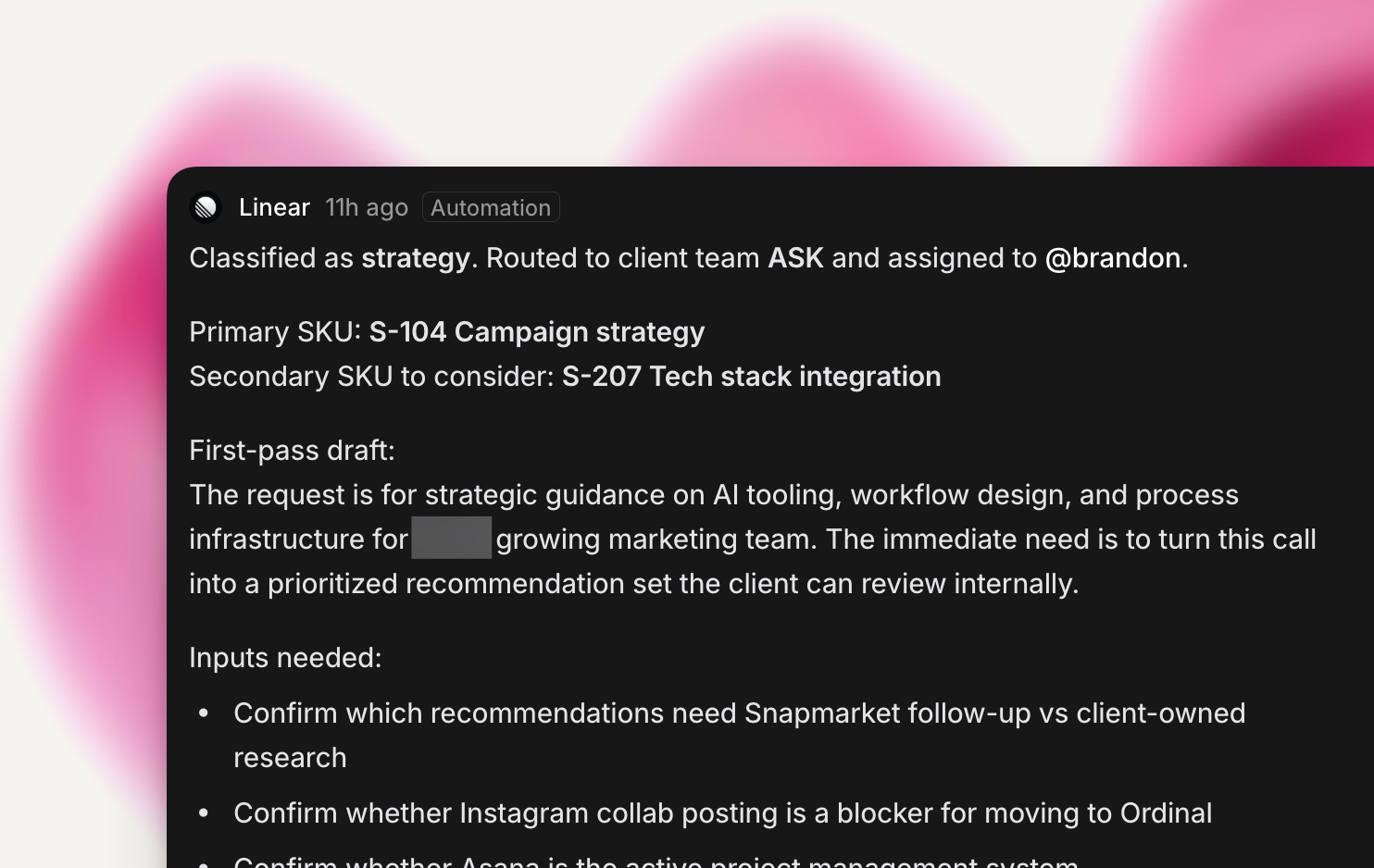
SKUs.md is the latest addition, where we describe all the services we offer in a comprehensive library indicating scope requirements and other things, which is useful for measuring profitability and capacity. This is also useful for our Linear Agent to triage incoming requests.
Finally, we have files for each client and skill so agents know who they’re talking to and what they’re doing.
By the way, I’m using Cursor to edit these files and push to GitHub.
Use Claude Cowork as your default app.
In my experience, Claude is far more capable than other AI tools, and Claude Cowork is far more capable than regular Claude Chat. It can think longer, handle complex tasks, and it even assigns sub-agents to execute tasks in stages, all to varying success. I’ve also found that scheduled activities like Monday briefings, client audits, and call prep work pretty well with the right context and connectors.
If GitHub is the brains of the operation, consider Claude Cowork as the connective tissue and muscles that hold all the organs together to get to work.
Don’t worry about OpenClaw just yet. I’ll talk more about that some other time.
Always have a human in the loop.
The latest AI tools are really powerful. Truly. Thinking about what they can do keeps me up at night. However, remember that they’re like a great intern: Smart and capable, but they’re still learning and liable to make mistakes.
As such, build into your system an owner for particular roles, processes, and context that verifies the quality and accuracy of the outputs. It’s also helpful to have an orchestrator role, someone who understands how the whole system fits together.
So, what does all this do?
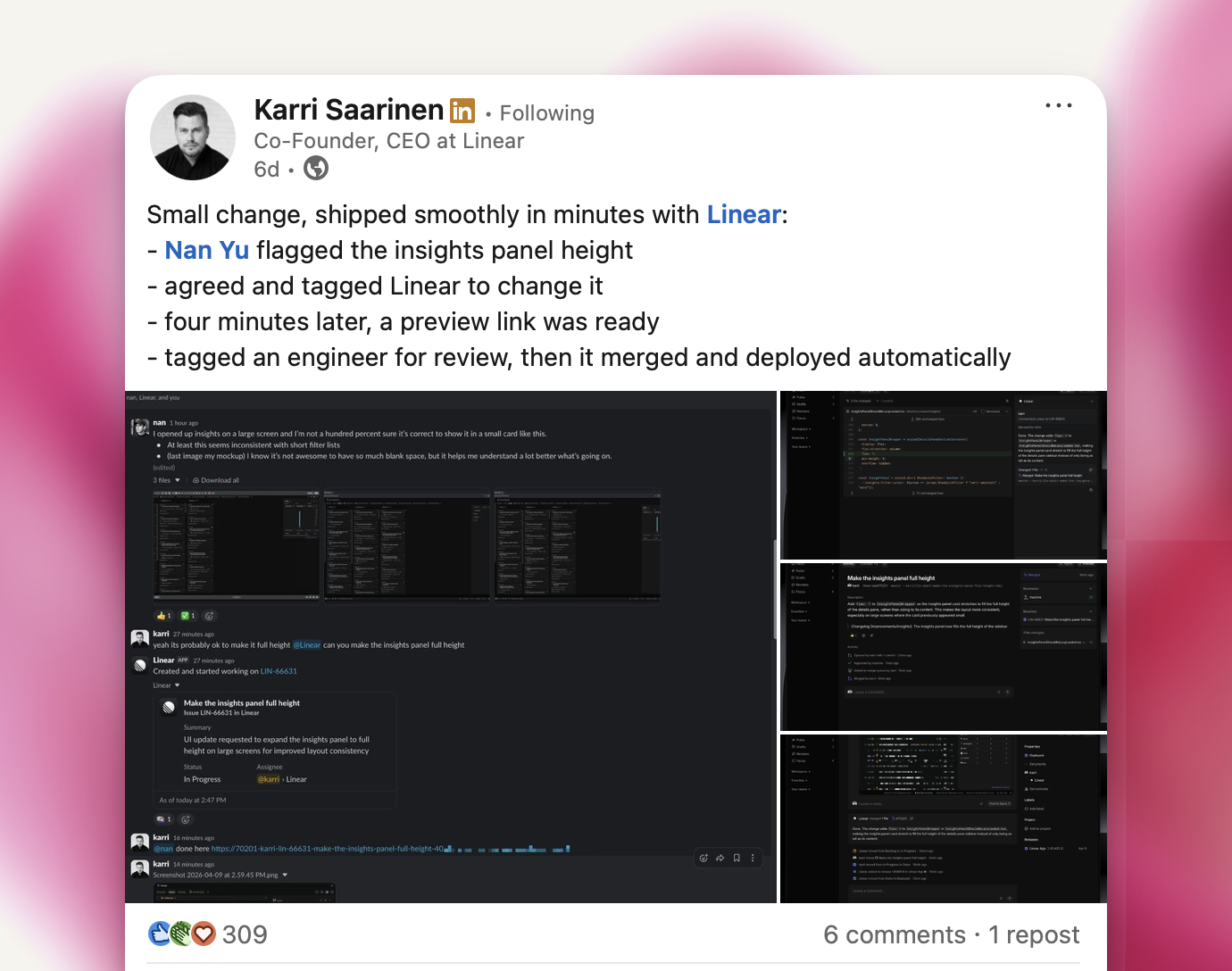
The gold standard for what AI agents can do well at this point in 2026 is best represented by a LinkedIn post from Linear CEO Karri Saarinen. After tagging @Linear in Slack, the agent created a ticket, wrote code reviewed by a human, then merged a fix. All in four minutes. It sounds simple, but you can imagine this would’ve been hours or days with the old way. Karri recently shared that their bug resolutions this quarter compared to last have increased 94%. They’re twice as productive working this way. Imagine if you were twice as productive as a company.
I grant that much of the AI hype these days is written by software engineers for software engineers. But my bet is that a lot of what we do from day to day as knowledge workers in services businesses is merely coordinating small tweaks and messages that individually are quick but in aggregate consume hours of our workdays.
For us those small tweaks look like updating Figma graphics, posting blogs or social posts to their respective platforms, exporting files, updating website pages, and so on.
You can see a recently-triaged call transcript automatically sorted and summarized based on a Granola recording. This helps coordinate knowledge to disparate team members so we can all share the load.
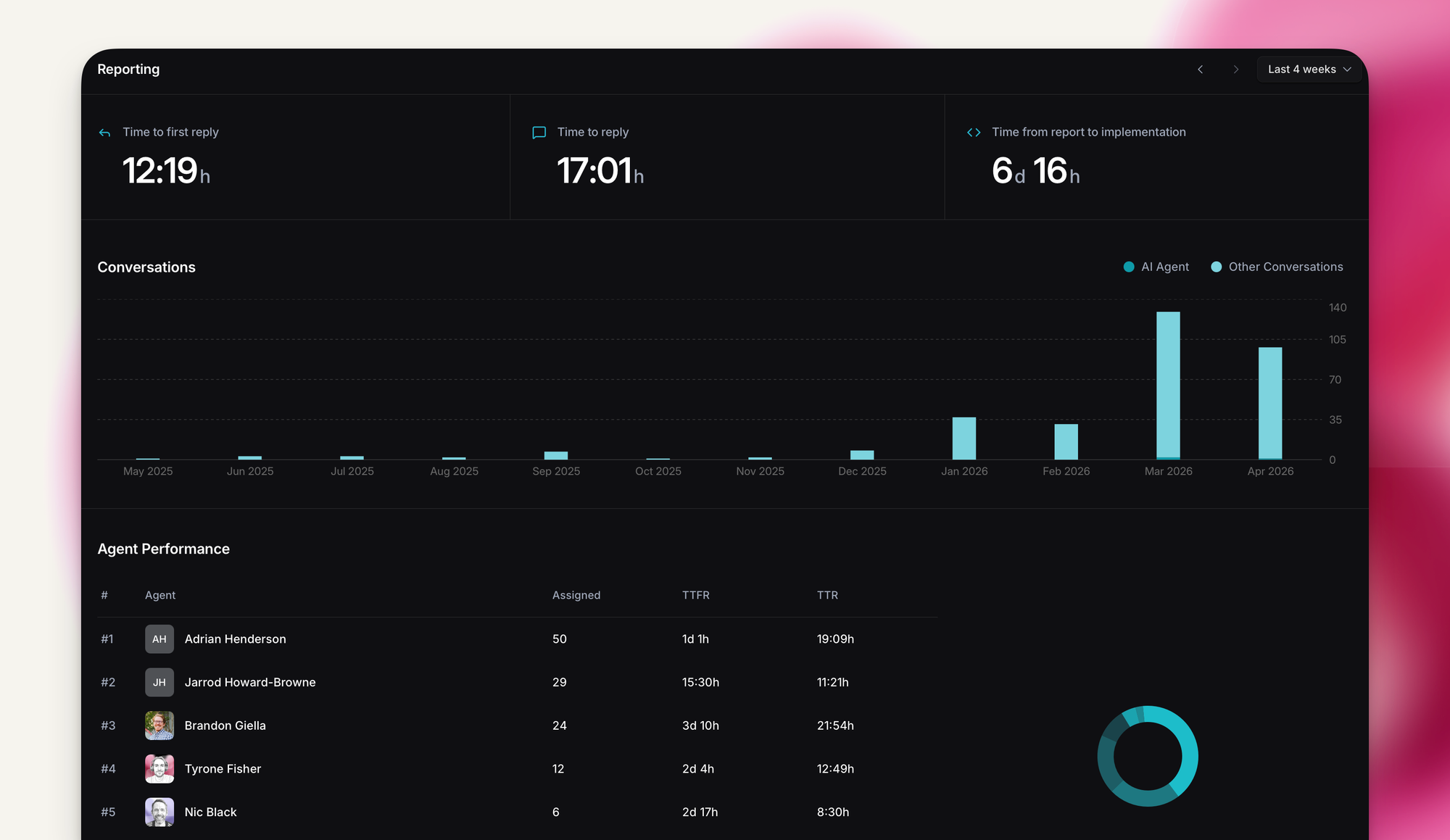
My aim with these updates is to improve our customer service by reducing our time-to-first-reply and time-to-resolution metrics for our service to a few minutes or hours. We’ll see how far we get.
All in all, I have a lot more to say about what AI can and can’t do, and how we’re using it. For now, know that it’s a highly contextual process depending on your own needs and tech stack. I can safely say I’m seeing massive benefits from it in just the last two weeks as our systems have improved thanks to new MCP capabilities and feature releases. What a time to be alive.
If you have questions about how you can improve your operations with AI agents, I’d love to chat! It’s a frontier space and we’re learning a lot as we go.
As always, we’re grateful to serve.