
What makes good storytelling?

A client and I were talking yesterday about an Instagram campaign to reshape the culture of his industry. The challenge is helping his team understand the power of storytelling in that way. They needed storytelling about storytelling, if you will.
The building blocks for a good story are these: A character desires a better world, but a challenge—often a villain or antagonist—stands in their way and exposes the internal weaknesses of the main character, which the story unfolds as the greater challenge. A wiser, older guide helps the character navigate the high stakes between success and failure.
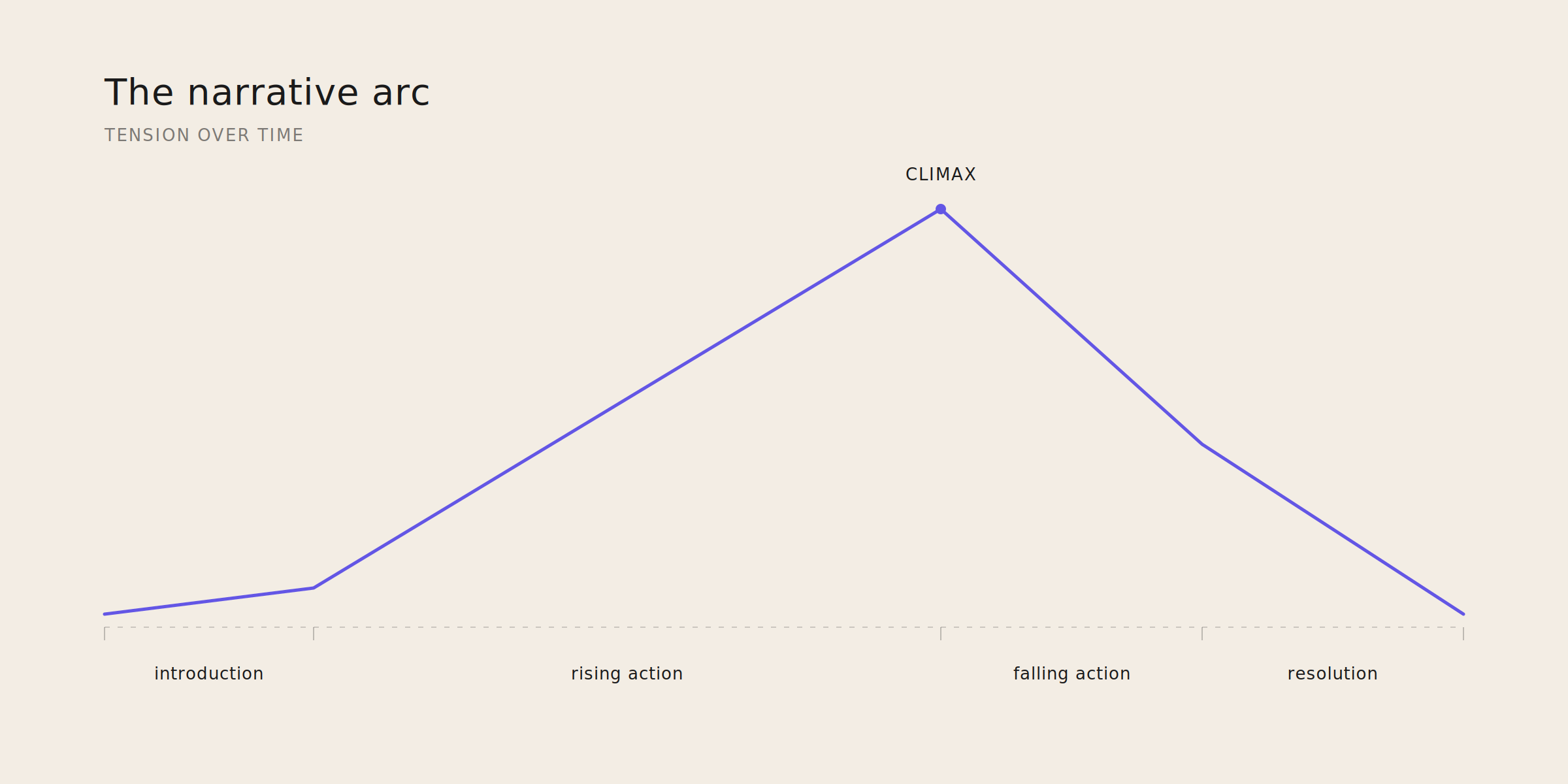
These core elements hang on a traditional, five-part storytelling frame comprising the introduction, the rising action, the climax, the falling action or denouement, which eases the tension created by the rising action and climax and works toward the resolution, that satisfying feeling where we learn that everyone lived happily ever after. That’s the shape of any good story you’ve ever heard, including poetry and investigative journalism and economics reports, as well as your standard novel. It’s also the shape of our lives.
The tension that builds upward toward the climax is the most important element of any story. British playwright William Archer once said that drama is anticipation mingled with uncertainty. We must feel the stress the protagonist feels. We can’t hold it too much or for too long, but it must get inside our bones and move our souls. Without that tension the resolution is just information.
Two models can help us build good stories.
The first is the full narrative arc. StoryBrand is the popular version, and their core insight is right and worth repeating: Your company is not the main character. Your customer is. You’re the guide. The weakness of StoryBrand is that it underweights positioning, which April Dunford defines as the mental space you occupy in a market, the place where customers evaluate you against the competitors who are also promising to solve their problem. Without a clear position, the challenge in your story is fuzzy and the stakes don’t create tension.
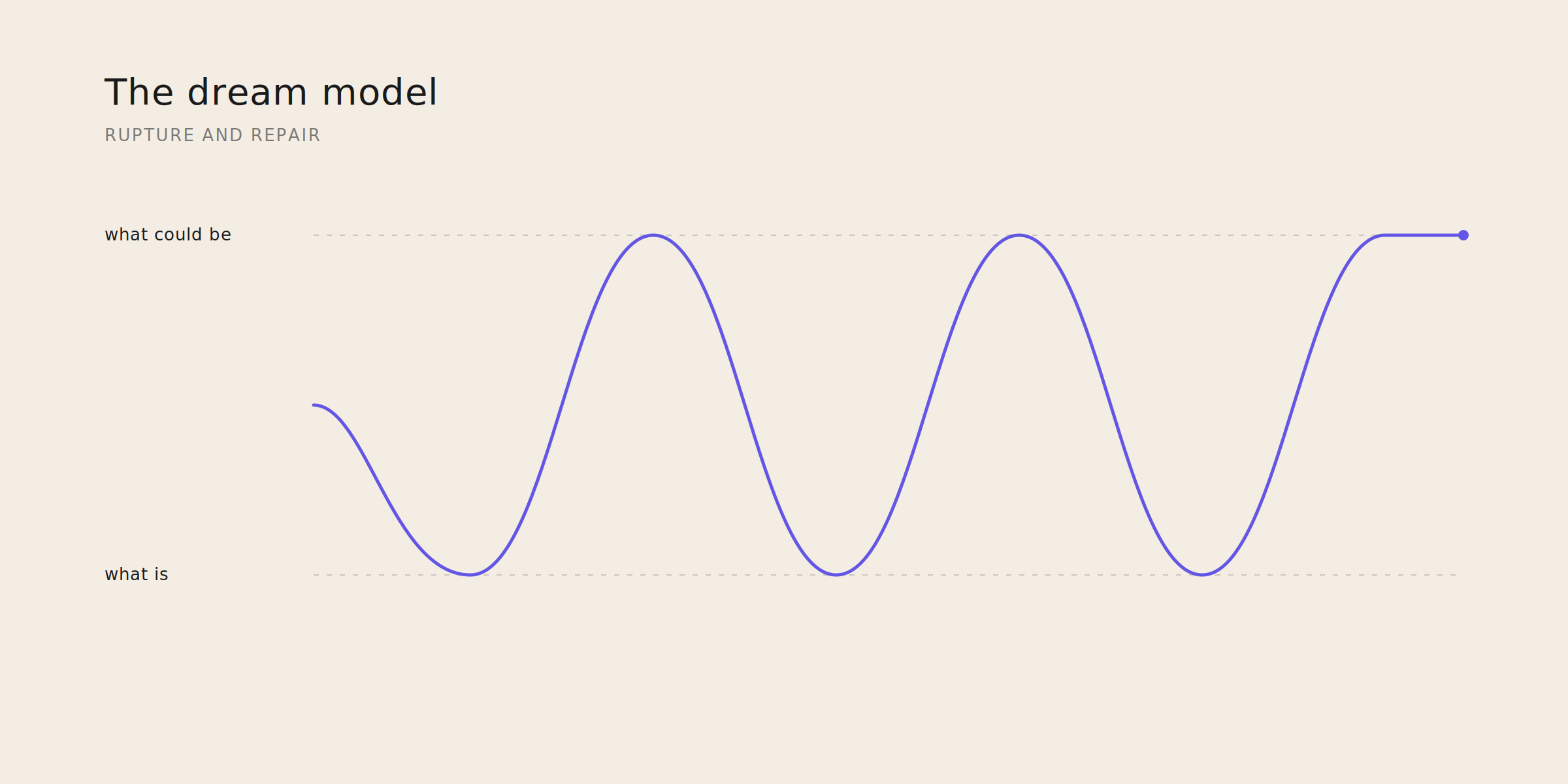
The second model, call it the dream model, comes from Duarte, a premier storytelling firm for the world’s biggest brands. This model is best illustrated by Martin Luther King Jr.’s speech “I Have a Dream,” which was influenced by Langston Hughes’s poem “I Dream a World.” The rhythm is back-and-forth—promised land, then dust of the earth, then promised land again. Tension and release. Rupture and repair. It’s how you build tension in seconds rather than chapters, which is what social media demands of us.
Why do some stories on the internet really move us and others don’t?
AI can create good content that has the elements of a story, but the one thing AI cannot do and will never be able to do is create tension by being vulnerable. A real person risks rejection by sharing their delicate inner world in front of another person. That’s why I keep thinking and writing about the importance of having a high anthropology in the age of AI. An audience knows nothing was risked with AI-generated content. If there’s no skin in the game, there’s no story.
When you see someone sharing something insightful, honest, raw on social media, a newsletter, or some other medium, you immediately sense all the elements of a good story. You see the character, the setting, the challenge, and the hoped-for solution, and the stakes they had to overcome to get there. But you also sense risk, uncertainty, the stakes. Think about the last thing that moved you. I bet it was something like this.
I’m leaning more into personal stories as the best vehicles for marketing. Podcasts still have this flavor and power. So do the case study, the testimonial, the founder writing about the moment they almost lost the company—these are the rare, liminal places where a person actually puts something on the line, and you can feel it. That feeling is the tension. That tension is the story.
Which brings me back to my own. I’m a marketing agency owner settling back into the basic building blocks of telling good stories that grow my clients’ businesses in real ways. The challenge for me and my team—and this is our story—is finding efficient, cost-effective ways to brings these stories into the light. I’ve realized in this process that my villain isn’t AI slop. My villain is time.