Back to basics
The latest AI tools can do so many things well, but I’m starting to believe they can’t do well the things that matter in marketing: high-quality writing and design. Beauty. Craftsmanship. Counterintuitive or unique approaches. Things that make you think differently about a problem or solution, things that might seem slightly silly on the surface but are nonetheless true and effective.
By design, AI tools are statistical machines that guess the most likely word or design trend based on a normal distribution. It’s just math. An amazing use of math. That means these tools are always drawn toward average, toward the middle of the distribution curve.
However, great marketing almost never exists in the middle. It exists on the long-tail edges, where a talented copywriter agonized over the mot juste for the headline, where a turn of phrase or layout choice sticks in your brain days or even years later. Print ads from The Economist are my favorite examples.
Rory Sutherland, Vice Chairman of the ad agency Ogilvy, wrote a book called Alchemy describing, as the subtitle puts it, “the magic of original thinking in a world of mind-numbing conformity.” Over the decades of performing tests and driving results through advertising, he found that logic and data have only limited use.
“We discovered,” he wrote in the foreword, “that problems almost always have a plethora of seemingly irrational solutions waiting to be discovered, but that nobody is looking for them; everyone is too preoccupied with logic to look anywhere else. . . . It’s true that logic is usually the best way to succeed in an argument, but if you want to succeed in life it is not necessarily all that useful; entrepreneurs are disproportionately valuable precisely because they are not confined to doing only those things that make sense to a committee.”
Every great idea is sanded down by a committee of average. AI is literally that committee but at incredible speed and power. I’m beginning to wonder if the work that shows up in LinkedIn feeds should be more human-crafted. Our AI workflows still have enormous use, so where should we apply what one colleague called “friction”? That’s that attention to detail or ingestion that is precisely at a human pace.
Through his experience, Rory codified eleven rules for bringing more magic, or alchemy, into marketing and advertising:
- The opposite of a good idea can also be a good idea.
- Don’t design for average.
- It doesn’t pay to be logical if everyone else is being logical.
- The nature of our attention affects the nature of our experience.
- A flower is simply a weed with an advertising budget.
- The problem with logic is that it kills off magic.
- A good guess which stands up to observation is still science. So is a lucky accident.
- Test counterintuitive things only because no one else will.
- Solving problems using rationality is like playing golf with only one club.
- Dare to be trivial.
- If there were a logical answer, we would have found it.
I’m thinking about ol’ Rory today because I keep seeing the same patterns in our yearning for craft amid AI outputs, in the performance data, and in feedback from clients. The work that moves people is human, made by someone who cared, and often a little strange. That’s the work we can’t outsource to AI.
None of this means we need to throw our tools away. Rory argued in one section that “the biggest progress in the next 50 years may come not from improvements in technology but in psychology and design thinking. Put simply, it’s easy to achieve massive improvements in perception at a fraction of the cost of equivalent improvements in reality.” That technological progress allows us to focus and scale communication, project planning, and the scaffolding for our work. We aim to keep costs down, after all.
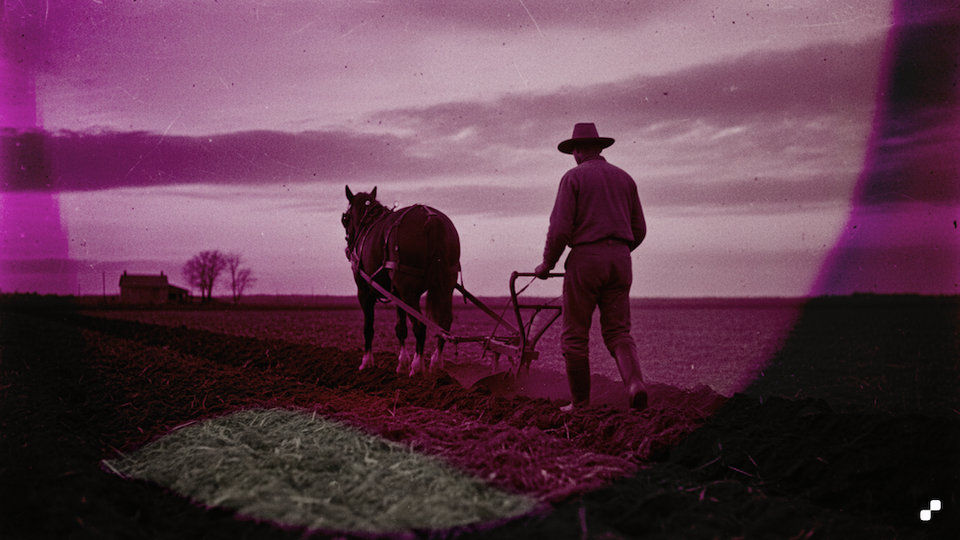
But the real skill isn’t using AI, and it isn’t refusing it either. It’s discernment, knowing which parts of the work are scaffolding and which parts are the thing itself. For the scaffolding, use every tool we have. But for the thing itself—the headline, the idea, the moment a reader feels something—at some point, whether it’s for our own, our clients’, or their audiences’ sakes, a man just needs to put his hands to the plough and press those keys himself.