Anthropology and epistemology: The two towers
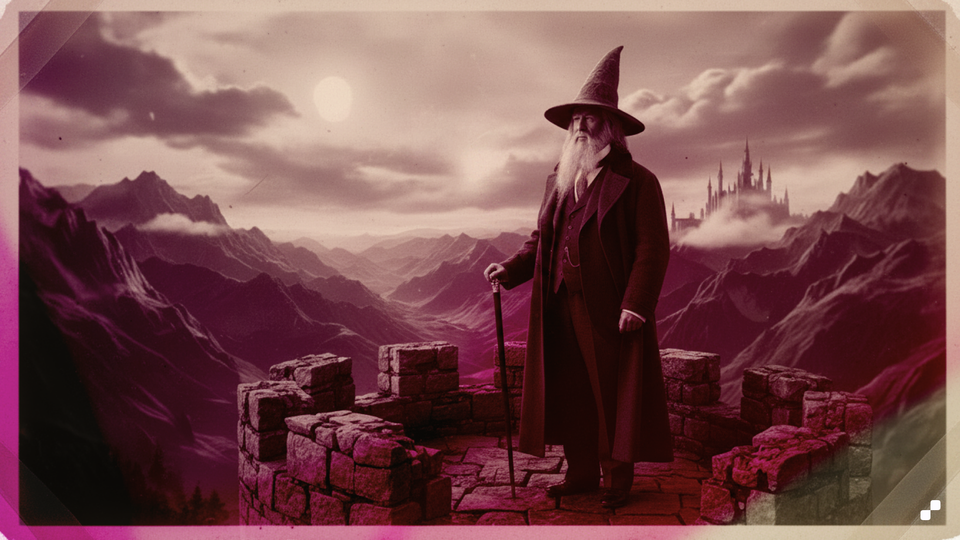
The two towers casting their long shadows over the AI landscape are anthropology and epistemology. Anthropology addresses the question of what it means to be human, while epistemology addresses the question of how we know what we know. I’ve written about the latter in my theory of knowledge, so now allow me to write on the former.
The study of human beings illustrates, among other things, that our species has severe limitations. We are—to borrow from Nietzsche—human, all too human. The promise of AI is that we can be free of these limitations through some kind of knowledge or skill, the modern ancestor of Gnosticism or even magic. Today’s tools don’t shy away from the claim of magician: Canva calls their tool “Magic Design,” and the default icon for AI has become the little sparkle, presumably twinkling at the end of a wand.
Where both shadows of the towers meet, to carry the metaphor, seems to be at the limits of our brain, an organ that appears to have both a physical and epistemological limitation. The problem we’re finding is that magic can’t conjure a bigger brain.
Caltech researchers argued in a study published in Neuron from December 2024 that the human brain has an “unbearable slowness of being” in the rate at which it processes information. While your wi-fi processes around fifty million bits per second, our brains process information a rate of only ten bits per second.
That limitation means you can have gigabit internet with the most advanced chips and AI tools on the market, yet a human brain must slow down enough to review all that those tools have produced. A person scrolling LinkedIn at ten bits per second is already rationing. Every piece of content you publish is competing against everything else that brain will encounter that day.
In short, we are creating more content than we can physically comprehend.
When supply grows exponentially against a fixed anthropological ceiling, the marginal value of generic content trends toward zero. Every undifferentiated blog post, newsletter, or podcast competes in a market where the total demand cannot expand. The price of ordinary attention collapses. But content that actually clears the filter and earns its way through becomes very valuable.
That raises an interesting question: How can you help your audience allocate the incredibly scarce resource of their attention?
I think it’s coming down to trust. Your audience must trust that what they see from you captures their problem authentically, and that you can help them solve it. Well, how do they decide that?
The paper in Neuron also mentions that “our bodies’ sensory systems gather data about our environments at a rate of a billion bits per second, which is 100 million times faster than our thought processes.” The brain can’t consciously evaluate everything competing for its attention, so it doesn’t try. It delegates the filtering problem to subconscious heuristics, the kind that operate at the sensory layer, not the cognitive one.
What the body processes at a billion bits per second is pattern, relationship, and aesthetic coherence—signals of trustworthiness that arrive before a single word is consciously read. These signals do most of the work in a reader’s decision to stay or leave. That means stories and aesthetic details that signal quality are now the primary competitive asset—not volume, not speed. If you’ve ever read Kahneman and Tversky’s Thinking, Fast and Slow or Rory Sutherland’s Alchemy, you’ll understand the power of these intuitive heuristics.
It’s our job as marketers to devise ways to take the most advantage of these AI tools given our anthropological and epistemological disadvantages. The tools get more powerful every day while the bottleneck stays fixed at ten bits per second. The only durable advantage, then, is the kind of signal that earns its way through the filter, and earning that has always required something AI cannot produce on its own: the genuine act of seeing another person clearly enough that they feel it.