AI trust disruption
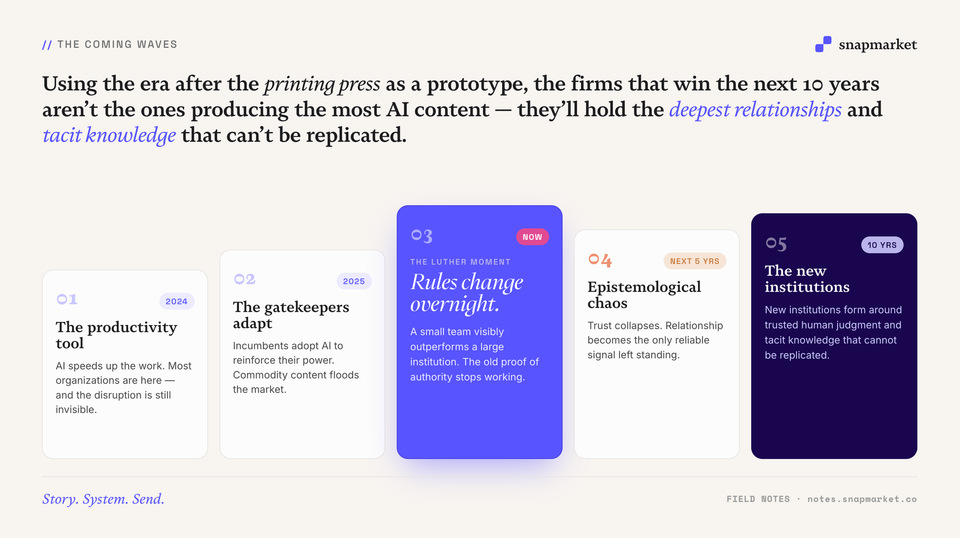
The printing press left a wake of dismantled institutions. Scholars argue that disseminating information at that scale changed people’s relationships to religious and political organizations. We’re going through a similar period with the advent of AI.
Gutenberg’s press was invented in the mid-15th century and carried Luther’s 95 Theses from Germany to the four corners of Europe. Additionally, so-called vulgar translations of the Bible from Luther, Tyndale, and others transformed the text from high, academic Latin into everyday English.
The Catholic Church argued that the people’s interpretations would splinter the church into thousands of factions. That turned out to be accurate. Authority shifted from an institution to individuals. These factions in part led to the wars of religion—the French, English, and Dutch civil wars that led to settlements like Peace of Westphalia—reshaping European power. A century later, the same machine printed the pamphlets behind the American and French revolutions, ultimately reshaping global power.
All from a metal letterpress.
What’s interesting to think about is that the press didn’t arrive into a stable world. The Black Death had already killed something like a third of Europe and hollowed out the institutions that survived it. Greek scholars and their manuscripts had been trickling west, which turned into a flood when Constantinople fell in 1453, just as the first printed books were circulating.
An epidemic combined with a new technology completely transformed millions of lives over the course of a century or two.
Today, Covid reshaped modern businesses, arming individuals working at home with a new power over their employers, religious leaders, and politicians. Then a new technology empowered these individuals to spread new information, create new products, build whole new companies. Claude Code was an internal side project from a single developer. That single developer radically reshaped the lives of millions of other developers. We’re all developers now.
It just hasn’t taken centuries. It’s taken only a few years. Maybe a few months. Claude Code was launched publicly last May. Today, my clients’ reps and administrative staff can build interactive assets and dashboards while they sleep.
Everything has changed. And nothing has changed. If you’ve seen (or read) The Odyssey or the book of Ecclesiastes, you’ll know that we humans merely repeat history, or at least rhyme with it. Our instincts, desires, cravings carry us on. The details change, but the arcs remain the same.
What gets buried in these transformations is a signal of trust, of relationships. I think that’s where markets could come in. They restore trust. The Nobel-laureate economist Friedrich Hayek argued that prices act as a trust signaling mechanism. Hayek’s price system works because it aggregates dispersed, tacit knowledge without requiring anyone to articulate it explicitly. Reputation is a Hayek price signal for trust. So is expertise or craftsmanship.
AI distorts these signals. It floods our information systems with synthetic information that’s indistinguishable from real information. Reviews, testimonials, case studies, credentials, even thought leadership—all can be mass-produced, which makes information almost meaningless.
This is Akerloff’s used-car problem at scale, what he called “a market for lemons.” When buyers can’t tell real quality from a good simulation of it, they rationally bid the price down toward average. Sellers of genuinely good work won’t accept that price, so they leave. Average quality falls. Prices fall further. Eventually only the lemons are left.
This is already happening in marketing. Everyone I know is moving up-market to produce higher quality, more thoughtful stories, or they’re moving into more detailed, technical implementations like the agentic revenue workflow I wrote about on Monday. We’re aiming for both higher quality as well as more technical engineering.
I’m hopeful for the next era of marketing. Every information technology since the press has run this same course, and the resolution has never been technological.
Early print was chaotic, just like marketing is now. There was piracy, forged editions, books published under the names of authors who’d never written them. Readers genuinely could not distinguish a real edition from a counterfeit. What eventually made print trustworthy wasn’t a better press but decades of slow social work: guilds, licensing, imprints, personal reputation, networks of credit among printers who knew each other.
The telegraph made distant reports unverifiable and produced wire fraud, which then produced news agencies to vouch for what came over the wire. Radio flooded the spectrum and produced licensing. Television produced standards departments. We’re still not sure if the moon landing happened. I’m joking. The internet is constantly working on producing verification mechanisms. Cue the bots flooding our analytics right now.
Every time, though, the process is the same. Just the details change: The technology collapses the cost of production. Counterfeits flood the channel. Existing authentication fails. And then the industry reforms around a new authentication layer—one that’s almost always social, relational, and slower than the technology that broke the old one.
When trust in mass institutions fails, people fall back on what they can verify in person: relationships, apprenticeship, reputation earned in a place over time. I’m aiming Snapmarket to be a place built on a foundation of trust in relationships.