A philosophy of marketing
I got a book yesterday called A Swim in a Pond in the Rain by the novelist George Saunders, and one line stood out right away. Saunders is talking about teaching writing, and he quotes the Russian short story writer Isaac Babel: “No iron spike can pierce a human heart as icily as a period in the right place.”
That line inspired me because I have been under-emphasizing the importance of details in a lot of my work over the years. And I have had this renewed vigor to be much more detail-oriented—much more nuanced and craftsman-like, if you will, in marketing.
We are very detailed creatures. From my undergrad as a creative writing major, and from being a writer, editor, and marketer over the years, I’ve realized the things that connect are extremely detailed. Very nuanced, very specific, very concrete. That’s why great poetry resonate—it’s the concrete imagery that makes it sing.
So I’ve been putting together a framework called the placial-modal frame. It sounds very esoteric and academic. In part, it kind of is. But my hope is that it’s very practical. Call it a diagnostic tool for marketing.
The modal side
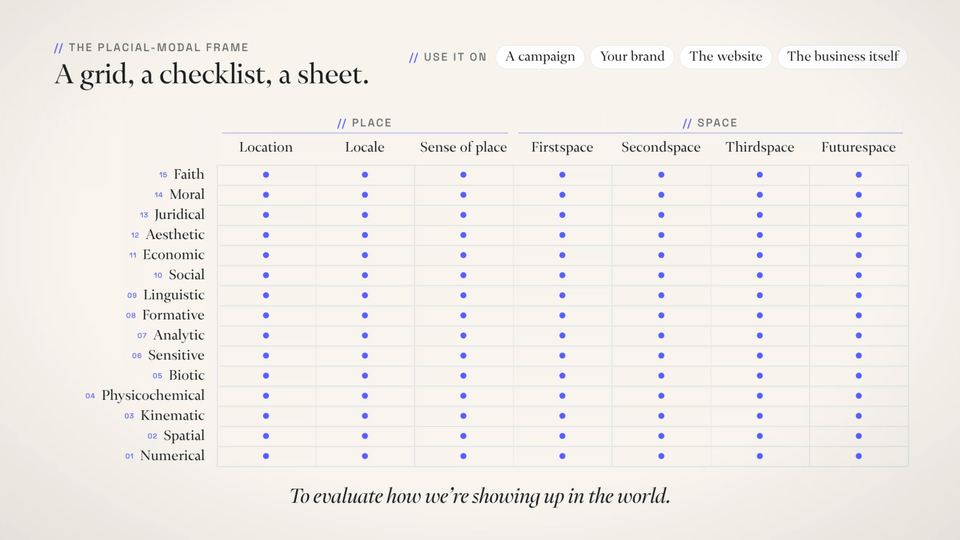
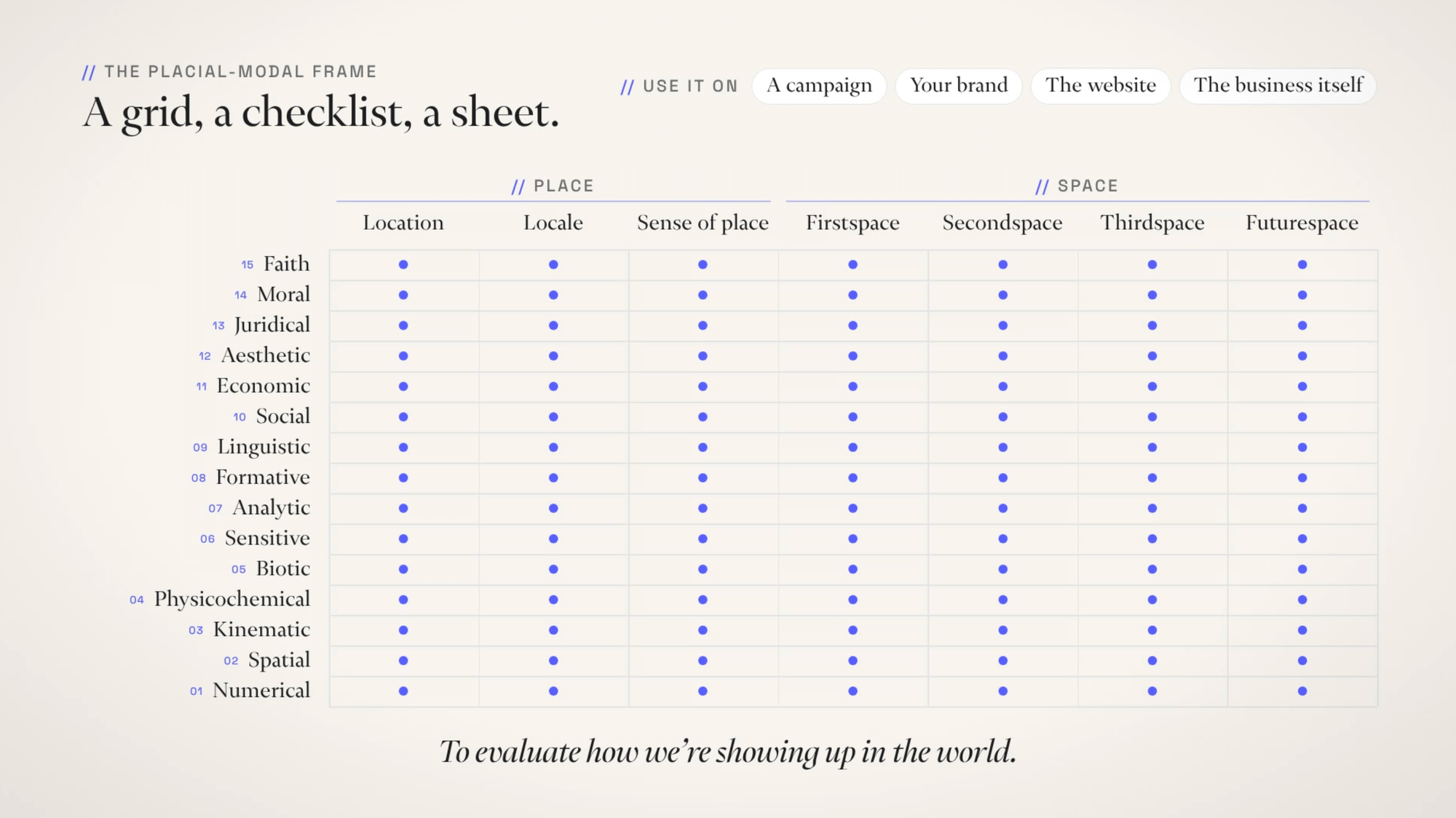
The first inspiration is Herman Dooyeweerd, a Dutch Reformed philosopher. Craig Bartholomew at the Kirby Laing Centre for Public Theology in Cambridge, of which I’m an associate research fellow, sent me a book on Dooyeweerd’s intellectual legacy. Dooyeweerd argues there are fifteen irreducible aspects of reality, and all of reality inhabits all of them at once: numerical, spatial, kinematic, physicochemical, biotic, sensitive, analytic, formative, linguistic, social, economic, aesthetic, juridical, moral, and pistic, or faith.
But what often happens in marketing, in running a business, in being an expert, is that one lens overshadows the others. Usually it’s the economic, but you could think of a marketing campaign, for example, through the lenses of other aspects:
- Aesthetic: How is this going to look visually?
- Social: How will it appeal to the different buyers in your market segment?
- Economic: How will it drive revenue (since that’s often the point of marketing campaigns)?
- Linguistic: What’s that headline? How am I going to position the product?
- Juridical: Is this a just campaign? Is it honoring the different people it’s going to affect?
- Moral: Are we producing things that are actually true, good, and beautiful in the world?
The placial side
The placial part is from my friend David Larsen, whose PhD dissertation on placemaking I helped copyedit. David talks about how our mission as creatures, in a very broad sense, is to create a place where God would dwell—a just, beautiful, harmonious sense of place, a sense of shalom.
For a business, that’s the sense of place people get when they land on your website or your marketing material. Are they drawn to beauty? Do they have a nice customer experience? (One could argue that the employee experience and the customer experience represent placemaking language.) It grounds you in one question: Do you feel taken care of here?
David names three aspects of place—location, locale, and sense of place—in addition to firstspace, secondspace, and thirdspace, and adds what he calls futurespace: Are the things we are building thinking about the future of the place they’re inhabiting?
Putting them together
So the sketch I’m making is this: The fifteen aspects form a grid for analyzing a campaign, your brand, your website, or the business itself. Put them together with a sense of place, and it creates a framework to evaluate how we’re showing up in the world.
I’m in the very early stages. But it’s given me a vision for how I could make a truly good, true, and beautiful place with my business. Our Docs site is one way I’m trying to bring some place and harmony and shalom to the marketing operation.
I’d love to hear your thoughts on this idea.