A new era for Snapmarket

The world before us is uncertain. As meaning-making creatures, we crave to make sense of this tumultuous season. How do we do that? Our species has for thousands of years made sense of our world through stories. I would argue this is among the most important activities we knowledge workers can undertake in the coming years.
To illustrate the importance of stories, consider two contemporary stories that frame much of what we think about today.
One story—call it the “doomer” story—argues that AI will destroy us all, or at least destroy the employment rate. Jack Dorsey can lay off 40% of his workforce because, with the dawn of the AI age, “something has changed. We’re already seeing that the intelligence tools we’re creating and using, paired with smaller and flatter teams, are enabling a new way of working which fundamentally changes what it means to build and run a company. And that’s accelerating rapidly.” Critics of Dorsey, believers of the doomer story, find the language and position of his recent statement to be merciless, inhuman. Perhaps they’re right.
The contrasting story says AI will usher in a golden age where “we can advance to a far superior way of living, and of being,” as famed venture capitalist Marc Andreessen wrote in his “Techno-optimist Manifesto.” He goes on to summarize the core argument of this story in one paragraph:
Economists measure technological progress as productivity growth: How much more we can produce each year with fewer inputs, fewer raw materials. Productivity growth, powered by technology, is the main driver of economic growth, wage growth, and the creation of new industries and new jobs, as people and capital are continuously freed to do more important, valuable things than in the past. Productivity growth causes prices to fall, supply to rise, and demand to expand, improving the material well being of the entire population.
Which story is true? Perhaps both simultaneously? Economies can grow and improve material well-being while at the same time impoverish other aspects of well-being, such as mental health and political stability.
The point is that they’re both merely stories. Even the most quantitative professions and data-driven businesses live and die by qualitative stories.
Aswath Damodaran, finance professor at NYU Stern School of Business and the world’s foremost valuation expert, argues in his book Narrative and Numbers for three reasons to pay attention to stories as a business leader:
The first, and most humbling, is the realization that much of what is offered as good business storytelling practice has been known for centuries, perhaps going back to primitive times. The second is that good storytelling can make a huge difference in the success of a business, especially early in its life. To be a successful business, not only do you have to build a better mousetrap, but you have to tell a compelling story about why that mousetrap will conquer the business world to investors (to raise capital), to customers (to induce purchases), and to employees (to get them to work for you). The third is that storytelling in business comes with more constraints than storytelling in novels, since you are measured not just on creativity but on being able to deliver on your promises. The real world is very much a part of your story, and much as you would like to control it, you cannot.
The business world, struggling to make sense of this chaotic environment, is waking up to the power of the sense-making story. That’s why a recent Wall Street Journal article emphasized the trend of major companies hiring so-called storytellers.
But what does this have to do with Snapmarket, with you?
Marketing is simply communicating the right message to the right person at the right time in the right way. For too long I have neglected the “right message” part of that sequence. I’ve found that a failure to properly identify the right story can lead to a failure everywhere else. That’s why the new era of Snapmarket will emphasize story in its proper place.
Yet I’ve also discovered that finding the right story isn’t enough. Sometimes the right story told to the right people requires an enormous amount of courage. The right story may alienate current customers or a huge cohort of your TAM.
Are you willing to focus on the smaller segment who will more easily connect with your story, improving the speed and conversion rate of your funnel? Is your board or investors or employees aligned? Do they understand that “educating” your buyers is actually expensive, a drag on your marketing resources? What if you’re pigeon-holing yourself, they may say, in a particular market or to a particular audience—and the message falls flat, leaving us worse off than before?
These are real concerns and risks. I wrestle with them myself.
Additionally, telling the right story may also require revamping your operations and processes, the kind of people you hire or fire, the status quo of your business. Overcoming these hurdles requires another kind of courage: to keep walking toward a far-off vision while other members of your team and customer base may grow weary.
I believe that the most successful businesses and people identify the right story through a process of clarity and focus, and then have the courage and conviction to act on it. It’s a call and reminder to myself as much as anyone.
We also can’t neglect the people behind those stories. At the bottom, we are human beings serving other human beings, compelled by stories and satisfied in details. As our website says, people are our proper occupation, and we will heavily emphasize the value, necessity, and joy of serving other people in relationship, trust, and quality.
At the other end of the techno-human spectrum, it must be said that a core component of this uncertain future is learning well the tools that are powering its progress: Claude Code, Cursor, GitHub, and so on. Leaders like us must be familiar with these tools and how they work, what promises and perils they hold.
As Jasper CMO Loreal Lynch noted in The State of AI in Marketing 2026 report, “Today, marketing sits at the center of enterprise AI adoption. No other function applies AI as broadly or as visibly across data, content, creativity, speed, and scale. What began as a productivity unlock has become a defining leadership opportunity for marketing organizations.”
Further, we must wrestle with the implications of not only productivity but what really drives the value in our businesses, the nature of the jobs and of the capital that power our businesses, and what AI tools are good for and what they’re not. Even knowledge and humanity are debated topics.
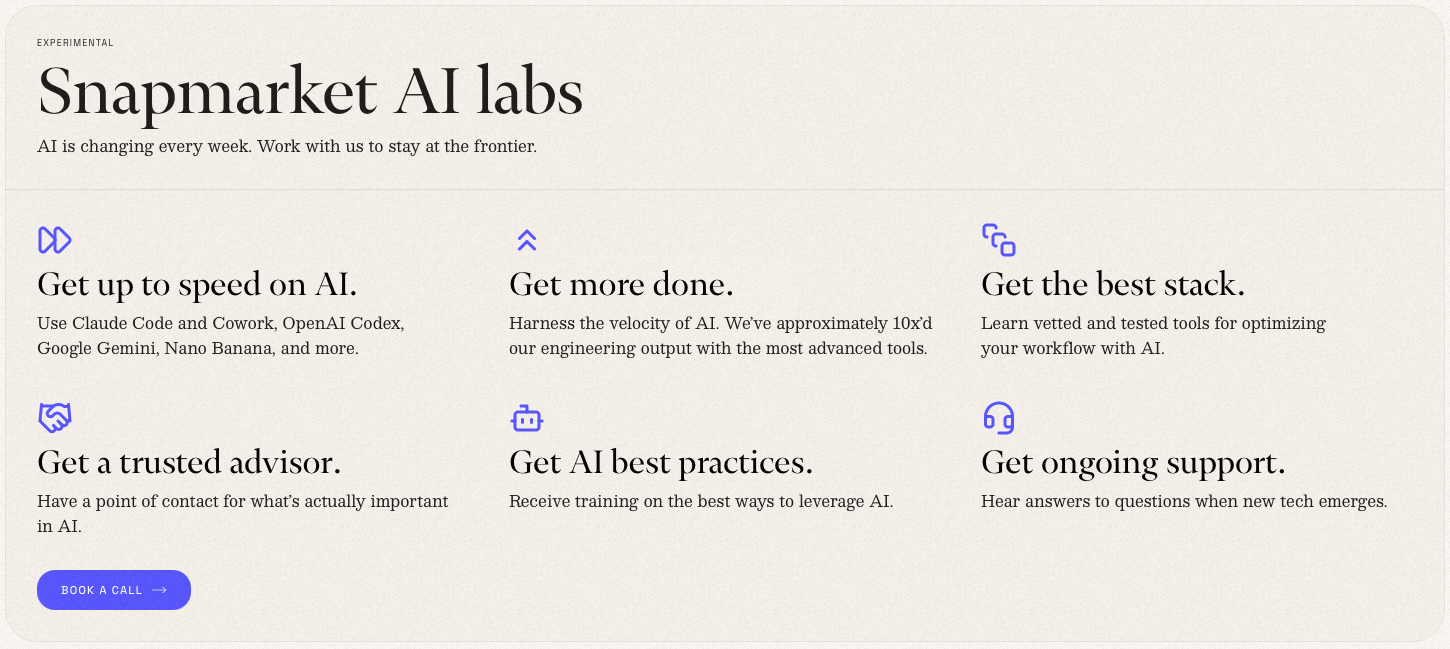
Hence our experimental AI labs, a practice area for AI consulting projects.
Lynch continued, “Speed and efficiency are no longer differentiators. The focus has shifted to impact, accountability, and value creation, and marketing can no longer operate in isolation.” See a forthcoming letter on anthropology and epistemology, the two towers in the age of AI.
I’ll be writing much more about these tools and ideas to help you make sense of what’s happening, though in no way do I claim to be a professional philosopher, attorney, or software engineer.
I should note that, though we use AI throughout our business in myriad ways, the words you see written by me will not be written by AI. These are my own words written by my own hand to help you, or at least myself, make sense of our chaotic moment.
So, with that, welcome to a new era of Snapmarket, where we emphasize the power of stories, the importance of people, and the value of paying attention to the smallest details.
I welcome your disagreements and disputations. Call me, write me, Slack me, knowing that, amid our dialectic, we may find the truth.
As always, we’re grateful to serve.